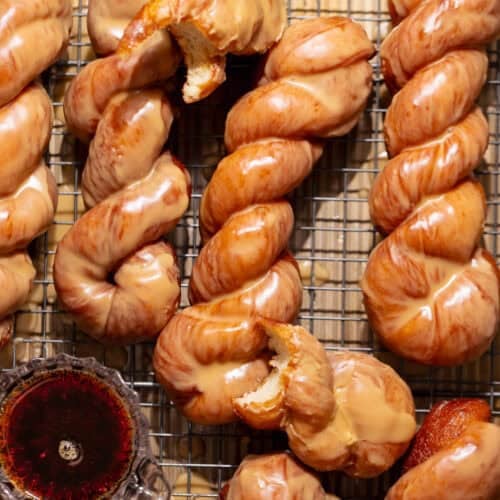
Maple Bars
Ingredients
For the Tangzhong
- 2/3 cup water
- 1/4 cup bread flour
For the Donut Dough
- 3 cups + 2 tablespoons bread flour *See notes below for measuring*
- 1/3 cup granulated sugar
- 1 tablespoon instant yeast
- 1 1/4 teaspoons fine sea salt
- 1/2 cup whole milk room temperature
- 1 large egg room temperature
- Tangzhong from recipe above
- 5 tablespoons unsalted butter room temperature
- Neutral oil, for frying Canola, vegetable, or shortening
For the Maple Glaze
- 1/3 cup pure maple syrup
- 2 tablespoons unsalted butter
- 1 1/2 cups powdered sugar sifted
- 2 tablespoons water
- 1 tablespoon maple extract
Instructions
Make the Dough
- In a small saucepan, whisk together the water and bread flour. Cook over medium heat, whisking constantly, until thickened into a smooth paste, about 4–5 minutes. Transfer to a small bowl and let cool until it feels slightly warm, but not hot or steaming.
- In the bowl of a stand mixer fitted with the dough hook, combine the bread flour, sugar, yeast, and salt. Add the milk, egg, and cooled tangzhong. Mix on low speed until a rough dough forms, about 2 minutes.
- With the mixer running on low speed, add the butter 1 tablespoon at a time, allowing each addition to fully incorporate before adding more.
- Once all the butter has been added, increase the mixer to Speed 2 on a KitchenAid and knead for 12 minutes, or until the dough is smooth and elastic.
- Shape the dough into a ball and place it in a lightly greased bowl. Cover and let rest at room temperature for 30–45 minutes.
- Meanwhile, cut nine rectangles of parchment paper, each about 6 inches long.
- Turn the dough onto a very lightly floured surface and roll it into an 8 × 9-inch rectangle, about 3/4 inch thick. Using a pizza cutter or sharp knife, cut the dough into nine 1-inch-wide strips.
- Working with one strip at a time, gently stretch it to about 16 inches long. Holding one end in each hand, roll the dough in opposite directions against the counter to create a twist. Bring the ends together, twisting them together 3–4 times, then pinch the ends firmly to seal. (See the in-post process photos or video below for a visual reference.)
- Place each twisted donut on its own parchment rectangle and arrange them across two baking sheets.
- Cover the baking sheets tightly with plastic wrap and let the donuts rise in a warm place for 45–65 minutes, or until noticeably puffy. When gently pressed, the dough should feel light and airy, with tiny bubbles just beneath the surface.
- About halfway through the proof, heat 3 inches of oil in a heavy-bottomed pot to 350°F (180°C). Clip an instant-read thermometer to the side of the pot to monitor the temperature. If the oil reaches temperature before the donuts are fully proofed, reduce the heat slightly to hold it between 350–355°F (180–182°C).
- Line a baking sheet with a wire rack and have tongs and a metal slotted spoon nearby.
- Working in batches of 1–2 donuts, carefully lower the donuts, still on their parchment, into the hot oil. After a few seconds, use the tongs to peel away and remove the parchment. Fry for 2 1/2 minutes total, flipping halfway through, until both sides are golden brown.
- Transfer the donuts to the prepared wire rack to drain.
Make the Maple Glaze
- In a small saucepan over low heat, melt the butter with the maple syrup, whisking occasionally until smooth. Do not let the mixture boil.
- Transfer the mixture to a large bowl. Gradually whisk in the sifted powdered sugar until smooth. Whisk in the water and maple extract until the glaze is smooth and pourable. *If you prefer a thicker glaze, omit one tablespoon of the water.
- Once the donuts have cooled, dip the tops in the maple glaze, allowing any excess to drip off. Return them to the wire rack. You can double-glaze them if working with the thinner glaze. Let them set on the wire rack, then enjoy!
Video
Notes
*Measure your dry ingredients properly. This is my #1 baking tip! Never scoop flour into your measuring cup, as this always leads to using too much flour. Instead, use the spoon-level method. This means fluffing the flour first, then spooning it into your measuring cup/spoon. For the BEST results, use a kitchen scale!*
Storage: Keep leftover donuts in a single layer on the wire rack, loosely covered with a top or plastic wrap. Do not store the donuts in a sealed container. They will stay fresh for 1-2 days after frying.
